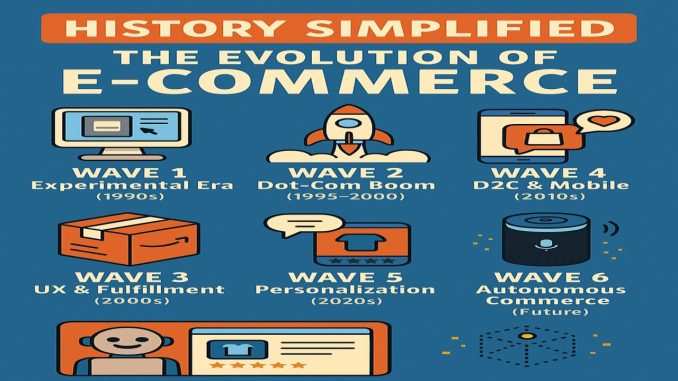
E-commerce, once a nascent concept primarily limited to books and simple electronics, has undergone a breathtaking transformation over the past two decades, particularly accelerating in the last ten years. What began as a convenient alternative to brick-and-mortar shopping has evolved into a dominant force in global retail, fundamentally reshaping consumer behavior, supply chains, and business strategies. This evolution is far from complete; as we stand in mid-2025, the landscape of online commerce continues to shift with remarkable speed, driven by technological innovations, changing consumer expectations, and a renewed focus on holistic shopping experiences.
A significant shift in e-commerce has been the dramatic rise of mobile commerce (m-commerce). A decade ago, online shopping was predominantly a desktop activity. Today, smartphones are the primary device for online shopping for billions worldwide, especially in mobile-first economies like Thailand, where many bypass traditional desktops altogether. The ubiquity of smartphones, coupled with enhanced mobile payment solutions, intuitive app interfaces, and the proliferation of social media platforms with integrated shopping features, has made “shopping on the go” the norm. Retailers have had to adopt a mobile-first design philosophy, ensuring seamless, responsive experiences across all devices, understanding that a frustrating mobile checkout can lead to abandoned carts and lost sales. This mobile dominance has fundamentally altered how consumers discover products, interact with brands, and ultimately make purchases.
Parallel to the mobile revolution, personalization driven by Artificial Intelligence (AI) and machine learning (ML) has moved from a novelty to an expectation. Early e-commerce sites offered generic product recommendations. Now, sophisticated AI algorithms analyze vast amounts of customer data—Browse history, purchase patterns, search queries, even time spent on certain pages—to create highly tailored shopping experiences. This manifests as hyper-personalized product recommendations, customized email marketing campaigns, dynamic pricing, and AI-powered chatbots offering instant, relevant customer support. These AI-driven tools not only enhance customer satisfaction by making the shopping experience feel uniquely curated but also significantly boost conversion rates and average order values. For example, if a customer in Bangkok frequently buys organic food and eco-friendly products, AI can ensure their online grocery store prominently features such items and relevant promotions.
Another profound change has been the integration of social commerce. Social media platforms, initially designed for connection, have seamlessly morphed into powerful shopping channels. Features like in-app purchases, shoppable posts, and live-stream shopping events allow consumers to discover products and complete transactions without ever leaving their favorite social media environment. Platforms like TikTok Shop and Instagram Shopping have transformed casual Browse into direct purchasing opportunities, blurring the lines between content consumption and retail. Influencer marketing, deeply intertwined with social commerce, has become an indispensable strategy for brands seeking to reach new audiences and build authenticity, especially among younger demographics.
Looking ahead, several groundbreaking trends are poised to redefine the “next” phase of e-commerce. Immersive shopping experiences, powered by Augmented Reality (AR) and Virtual Reality (VR), are no longer speculative but are becoming increasingly integrated into the mainstream. AR allows customers to “try before they buy” by virtually placing products in their own environment—imagine seeing how a new sofa looks in your living room or trying on a pair of eyeglasses via your smartphone camera. VR, meanwhile, offers fully immersive virtual showrooms where customers can walk through a digital store, examine 3D models of products from all angles, and interact with them in a truly experiential way. These technologies aim to bridge the sensory gap between online and offline shopping, reducing return rates and enhancing purchase confidence. As 5G networks become more pervasive, enabling the high-bandwidth, low-latency connections needed for these immersive experiences, their adoption will only accelerate.
The future will also see a strong emphasis on sustainability and ethical branding. Consumers, particularly younger generations, are increasingly conscious of the environmental and social impact of their purchases. E-commerce businesses are responding by adopting more sustainable practices, from eco-friendly packaging and carbon-neutral shipping options to transparent supply chains and ethical sourcing. Brands that authentically communicate their commitment to environmental responsibility and fair labor practices are building stronger connections with socially aware customers, driving loyalty and purchasing decisions. This shift indicates that “value” in e-commerce is no longer solely about price but encompasses a brand’s broader impact on the world.
Furthermore, conversational commerce and voice search are set to become more prevalent. With the rise of smart speakers and voice assistants, consumers are increasingly using voice commands to research products, compare prices, and even make purchases. E-commerce platforms will need to optimize for natural language processing and voice search queries, ensuring their products are discoverable through conversational interfaces. AI-powered chatbots are evolving beyond basic FAQs to become sophisticated virtual shopping assistants, guiding customers through their purchase journey, offering personalized recommendations, and providing real-time support. This shift towards conversational interfaces aims to make online shopping even more intuitive and hands-free.
Finally, the backend of e-commerce will continue to be transformed by advanced logistics and fulfillment technologies. As consumer expectations for faster and more reliable delivery continue to rise, e-commerce giants and smaller players alike are investing heavily in warehouse automation, drone delivery, and optimized last-mile logistics. Predictive analytics powered by AI will enable more accurate inventory forecasting, reducing waste and ensuring products are available when and where customers need them. The continued development of “dark stores” and micro-fulfillment centers closer to urban areas, exemplified by services in densely populated cities like Bangkok, will further shorten delivery times and enhance efficiency.
In conclusion, the evolution of e-commerce has been a dynamic journey marked by relentless innovation and a constant adaptation to consumer demands. From the early days of basic online catalogs to today’s hyper-personalized, immersive, and socially integrated shopping experiences, the industry has dramatically redefined retail. Looking ahead, the confluence of AI, AR/VR, sustainable practices, and advanced logistics will continue to shape an e-commerce landscape that is more intelligent, efficient, and deeply integrated into our daily lives, making online shopping not just a convenience, but an increasingly intuitive and engaging experience.