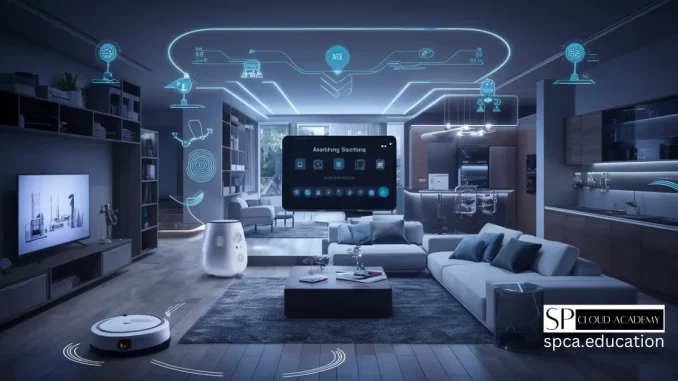
The idea of smart home has come a long way in the last few years. It runs through three phases, with #1 being single point solutions to #2 assembly or united actions for scaling up solutions; and finally – where we are today. This interconnected and personalized world is brought to you by the Internet of Things more than yesterday’s frontiers ever realized. The oil revolution will enable a completely different lifestyle which anthropologists yet need to study in detail. In its cradle, this leaves mankind posed at the door of renewed architectural achievements. This T. Revolution then ushers in a world of optimized interoperability, increasing efficiency by sharing data and experiences seamlessly without affecting operation at all. The Internet of Things (IoT) is Changing Everyday Life in Your Home: Now and in the Future Evolution of Smart Homes.
Smart homes started out as single devices like the programmable thermostat or IR motion sensors. Today’s smart systems are built by the integration of Internet of Things (IOT) technology which communicate, think and adjust their settings according to user habit. Smart Homes 2.0 no longer focuses on such aspects of care alone; this change to a wider emphasis of seamlessly blending sustainability, security and comfort, has been brought by the Internet of Things (IOT), Artificial Intelligence, and cloud computing. In other words, devices can now exchange securely shared information among themselves & give real-time advice to their users.
Smart Homes 2 Key Features: Enhanced Interoperability and Consistency Mobile internet devices based on IoT (Internet of Things) protocols like Zigbee, Z-Wave or Wi-Fi can talk to each other with seamless. This seamless continuity is guaranteed when your thermostat, light, speaker and security system followed by your smart home assistant are all interoperable providing an experience for the user from start to finish that flows smoothly and harmoniously. AI-Powered Personalized Design
Voice and Gesture Control Center
Smart speakers and picture-embedded assistant tools are making possible new forms of interaction. These artificial intelligences include Amazon’s Alexa, Google Home and Apple’s Siri. Add gesture control into every link of the system and all of a sudden there is full transmission.
You may not notice its existence, but you can’t ignore the benefits it brings.
Energy Efficiency and Sustainability Then there is the smart thermostat, an energy monitor and solar integration–all essential parts of Smart Homes 2.0. These machines can not only cut your bill in half, moreover they provide a way to live green and practice sustainability for the environment as well.
AI-enhanced security cameras can be used for many things, but they don’t just send a picture to the boss. These jobs monitor video in real time and alert you to anything funny, so that your peace of mind is not disturbed at night. Where AI can be inserted into each part of this privacy as a service pays for itself more quickly than with today’s standard methods. Abnormal situations will induce pings and appropriate responses from your management system.
How your daily life changes with IOT
In the morning: If everything goes according to schedule, the system will wake you gently with warm sun light; put the thermostat at an ideal temperature; start making coffee (you’ve never even left bed yet). Comprehensive Smart Health Inside Your Wearable Devices
Smart speakers, TVs and home theatres can all be set to the same beat via IOT. With a single voice command, a completely customised environment–from how much light to what soundtrack will get played back–is yours to enjoy. Remote Management
IOT has thrown open the door to control a house from any location. You’re in and out with just a light push. Best friend arrives? Use the secure app to remotely unlock the door. Inconvenience? There’s even miniscule details such as this can be controlled from afar now.
Areas of Difficulty
Apparently, while Smart Homes 2.0 can bring us untold benefits, it is not all like that.
— Privacy and Security: Iliot data was being collected in your own home through household things, this is cause for worry about hacking and unauthorized access.
— Compatibility Issues: Not all devices are good buddies. Bumpy gadgets which don’t connect seamlessly are one thing to keep in mind when building a smart ecosystem.
— Cost: While the cost of IOT devices is beginning to drop, a houseful of them can still add up to tens of thousands dollars. New Challenges for Smart Homes In future smart homes will be combined more closely with urban infrastructure such as smart grids and city-wide IOT networks. Innovations coming in the near future include interactive interfaces based upon augmented reality, biometrics aimed at increasing security and zero-energy houses.
Again, as the days of 5G draw nearer raises hope that it is possible for more speedily communicating IoT devices and uses yet greater computing power —— with faster. It has brought us closer to the day when those dream-of gadgets written in the most feverish moods are within reach. With maybe just a nudge here, and a sprinkle of imagination there, we may live to see with our own eyes this generation happen upon those self-thinking homes that experts are predicting almost around any corner.
Conclusion
IOT-enabled Smart Homes 0 handle this need in a intuitive, efficient and almost human way. Once IoT technology is further developed, homes will be smarter, cleaner and better connected. The course of our domestic lives will inevitably shift direction. Whether you are already a trendy techie or still unsure about Smart Homes 2.0, your future life experience holds a journey of exploration into the way to live tomorrow.