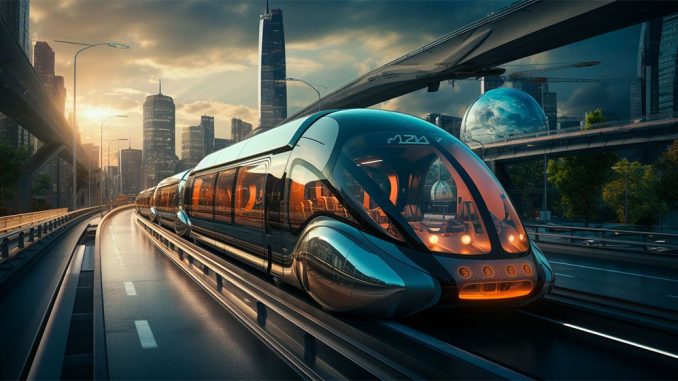
Of course!, some cars are even starting to drive themselves autonomously. This seems destined to deeply alter people’s lives and the shape of the city. But the pace of progress in these approaching auto cars is accelerating now. The changes and entirely new kinds of life they will bring to our passive existence is almost beyond all imagination. Next I’m going to talk about what cities will look like in the future. After all (AV)s arrive.
The Evolution of Autonomous Vehicles
The drive towards (AV)s has been a process of increasingly marked technological advancement. From very humble beginnings until now high sophisticated systems AVs can now navigate really complex environments without much human intervention. Companies like Tesla, Waymo, and Uber are at the frontier of this innovation trying to do everything possible to push the envelope on what might be achieved by these vehicles. The coming of AVs will likely result in fewer traffic accidents and less emissions per passenger mile, as transport networks become more economical.
Redefining Urban Mobility
The first and most direct effect of (AV)s will be on urban mobility. These cars promise to carry off traffic jams and to make efficient transportation a reality. AVs can communicate with one another and with smart city infrastructure, changing traffic patterns at lightning speed and making major congestion less likely. This system, linked as it is, could bring substantial reductions in journey times and (certainly) make cities easier places to get around further into the future.
Moreover, AVs could change the focus from individual car ownership to shared mobility services. As ride-hailing services introduce more and more AVs into their fleets, the need for private car ownership may (fall away). This change could mean a reduction of vehicles on the road to new levels, less congestion and environmental damage from transportation.
When autonomous vehicles become a reality, urban management will see much great change. At present, urban planners who work according to the principle that road systems should be developed around cars haven’t even started their tasks to be completed someday in the future!Accordingly, the streets springing up around new buildings are adding artificial things there just like Varadero with its buildings on either side– only people can not live in such places nor do they want to plant anything. As for those abandoned, former industrial sites in the heart of cities, many will soon become parks. The vast deserts wasteland found there will gradually change shade by day and bring a new sense of life to these areas.
If cities could create public spaces such as these from the parking-underneath, some redeveloped buildings that come later may very well turn out to be more aesthetic, lighter and even less costly than the original ones from which they are being built.Cities can in Future may yet Transcend this concept of sustainable urban growth into one where hacking is both beneficial and economic! Rearranged into more satisfactory forms, these leftovers would not have to be thrown away or left alone to rot. Instead, they might perhaps emerge as precious resources for recycling with people from all over town exchanging goods depending on one another’sWant.Dv’s is also a new opportunity for public transport.
The tourist package along cultural objects and cultural experiences can continue in Town E Using self-driving leisurely buses to get to a tourism zone–though no longer intertwined as tightly with its host city like the case at City A for Mainland Artist 3 or Chiangmai Buddha Film Studio outside Chengdu such music groups coming from America will find here less inconvenients In future when The Anniversary Concerts Hall opens as a huge cultural scenic place that transforms into Yet Another highest seat for Concert and Opera Performances,–in effect extending Tokyo’s cultural space beyond urinalsIn the future, employing self-driving buses, and jitneys which can be linked up with other transport ways like commuter trains and subways flexible methods are allowed in large cities-that should particularly suit international cities such as Tokyo or New York for instance.
They can eliminate the need of underground or open spaces for large parking lots next to rail stations and bus terminals and, during all times a day provide round-the-clock service for the whole system.The fastest, most direct way to get to work will no longer be by jostling with crowds on a rush hour train but in clean driverless environmentally-friendly independent “green” buses which set off from points immediately after one finishes work directly ahead of the next one and which take no more than five minutes from boarding until alighting at any given spot!Zhengzhou and a driverless bus
3.《Calling on China》: Our book “Calling on China,” which has been selling in Japan as well, provides intimate glimpses into the lives of Chinese people today. Hence, by involving all those involved these projects will greatly foster understanding between different segments of society–for they belong to no single corporation nor follow only one kind of transitional pattern. In other words, some investors may be overseas, others local Chinese entrepreneurs or state-owned enterprises.
ZhumalengHowever, despite the advantages of the widespread application of AVs, there are also many challenges. One of the main worries is that they will destroy jobs. If robots can drive cars instead of people driving them then many who now work in transportation industry would lose their livelihoods. As they are thus left without work, policy makers will need to help these people find new jobs.
Safety is another problem. Although AVs are expected to reduce the number of accidents resulting from human error but not due to their faults, safety is terribly important. Achieving that calls for electronic safeguards to be subjected to rigorous trials; cybersecurity measures must be robust and clear legal frameworks need to evolve. In addition, careful consideration will need to be given into the moral implications of using AVs for decision-making purposes in situations where peoples ‘lives or deaths hang in the balance’.
The Future of Cities in an Autonomous World
As more and more autonomous vehicles appear on the road, cities will have to change. Government and private companies are going to need to work hand in hand with the general populace in order to ensure that people can fully share in the fruits of autonomous vehicles. Urban planners will have to think about carefully how cities are arranged in order both to negotiate for flexibility and sustainability: how do these changes solve mobility problems? And how can elements be made more convenient for those who live close together?
We might look forward to such as the expected future ‘Smart Cities’ where AVs occupy a central part in forming seamless links between every single mode of transport that a city has, yet doing so environmentally-friendly and comfortably fitting into its surroundings at all points.
These cities might also feature dynamic routes, citywide traffic control capable of operating from any point to another and mobility solutions that integrate all forms of transportation in the dance of immediate transportation services in a way which is even more natural to human beings than it has ever been before.
The Final Thought
With improved technology and greater distribution, No doubt autonomous vehicles are going to convert transport and city planning in ways just teel., As they become more and more prevalent in the city, their impact on that form of human settlement is complete yet far less than what it might be. There are altogether new possibilities now opening up for higher efficiency, susta inability, and amiantus How everin or der to make the most of AV potential demands thoughtful planning, judici regulation, and a determination to roll back the problems they bring us. Without a doubt, the future of the city environment IS in autonomous vehicles, and what an adventure that is go ing to be!