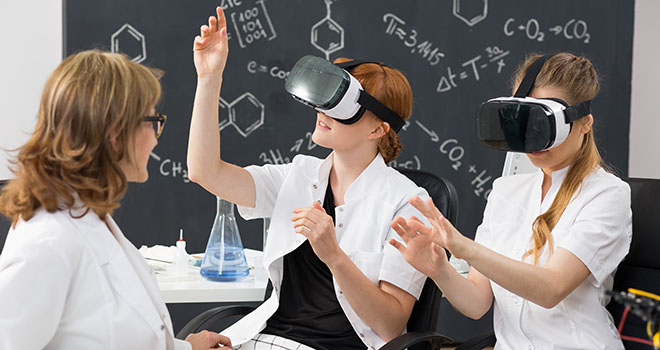
In today’s world, virtual reality (VR) is a new major instrument for education. Previously, it was a matter of students in the classroom talking one-on-one with the information-dependent teacher-or lecturing each other. Then a still-minority even exists for which I myself add up my money together with friends, in order for about half a year occasionally to require him help during questions classes. Two hours a day is very reasonable! This technology, once mainly associated with video games and entertainment, is now having a greater and greater impact on educational settings; it brings “intelligent” scenes into the novel installations that will deepen understanding, engagement as well as memory.
A Novel Dimension of Learning
Using VR, students may immerse themselves in a world that is entirely of their own design. This new method for experiencing out-of-the-box teaching materials has advantages over traditional forms of instruction.
Enhanced Engagement: Since VR brings students into a world not their own, the right class is definitely more enjoyable than it would be under traditional teaching methods. In this way entertainment in learning is often the learning itself. For example, if the students are headed to surface of Mars and diving towards the bottomless ocean after all: considering there is no room for questioning about how these new glamour magazines for women make us better looking – VR is undoubtedly an exciting and practical method of instructional design.
Experiential Learning: VR allows students to walk through concepts directly. For instance, students can not only read about ancient Rome, but they can even personally enter into its streets–find where the pyramids were located, observe many different historical landmarks, and touch or manipulate 3D models of historical relics. This sort of experiential learning is very helpful for enabling students to understand what is happening and to remember anything discussed or seen during class more easily.
Better Learning through VR
With VR, students are able to take their theories and ideas and try them out in a safe environment. Medical students can use virtual reality software for surgical operations, where as engineering undergraduates may virtually run the machines. Using simulations like this means that, while not running any risk of all this is what actually happens in circumstances — and it conveys some you:is is most important thing”a personal feel for your surroundings.”
Personalized Learning: In VR we can change (for example Units) to be suitable for individual student styles and rhythms. Cathy has got such adaptive virtual experiences now — the level of difficulty changes depending on how well a student does, and gives learners a highly customized way through the material which takes into account where they currently are in terms of personal life and current understanding.
Case Studies and Success Stories
A growing number of schools and educational institutions have begun to include VR in their curricula. For example, the University of Illinois College Medicine has used VR to simulate complex operations, thus giving students some experience in a controlled environment —before they step out onto operating room floors. In another instance, the Anne Frank House in Amsterdam developed a VR experience where students wander through Anne Frank’s secret annex. Through doing this, they can gain fresh insights into her life and the historical circumstances that shaped it.
Actuarial Challenges
Despite such possibilities for success, there are multiple forms of opposition to VR in education. For one, not every institution has the funds necessary for purchasing VR equipment or providing technical backup. Moreover, creating high quality educational content for VR requires considerable investment and expertise in mastering new technologies.
To address some of these difficulties, companies which produce educational software and educators are working together. Many educational VR applications, for instance, are being designed to work with inexpensive VR headsets: that makes the technology easier for schools and other educational settings to incorporate into their programs.
Future of VR in Education
The avenue through which VR technology can be played and supported is getting poster. Such developments in the education arena may include more elaborate VR experiences, better integration of artificial intelligence with personalized study for students, and use of tele-collaboration devices that allow students to work together in virtual space.
To sum up, VR is changing the way we learn. It brings immersive, stimulating and customized educational experiences into classrooms. There will be difficulties, but the potential benefits of VR in education could be enormous. Where (is) the technology becomes more and more affordable for more people,(there)It is likely that in the future children will learn and get their living information in this way. This makes study extraordinarily dynamic and effective.