A Trigger of Progress: After HumanityHas entered the Fast lane Again
From industry to industry, no other item in this era will be more influential than AI. Thanks to AI algorithms that give diagnoses in real-time and more accurately than man, equably quickly we find ourselves with better healthcare.Hence, it is typical of such systems that the responsibilities are divided. For example, in environmental science models have been launched on a computer which uses about air to predict weather trends and regulate the production of renewable energy. In e-commerce, businesses naturally consider AI for efficiency. Self-driving cars may mean fewer vehicle accidents–down from 1.2 million per year in the United States alone to just 30,000 worldwide by some estimates Ethical AI development ensures that new innovations do not come at the expense of dignity and civil rights for people.
Key Ethical Barriers in AI
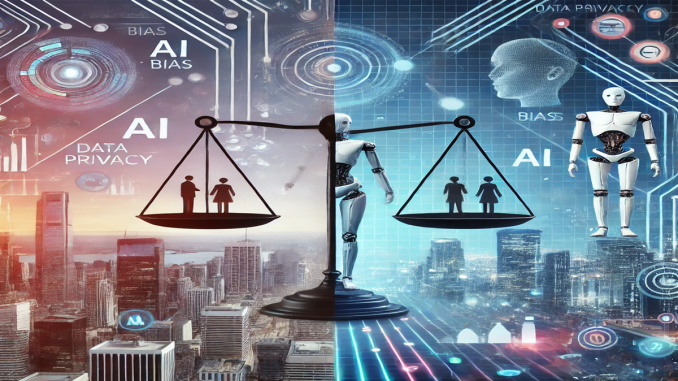
Bias and Fairness AI makes inferences based on data, which has social biases. If algorithms are trained with biased datasets, these same algorithms will reproduce only the existing discrimination and even generate new patterns of bias. A case in point: Imagine that a hiring process reflects bias in training data accumulated over many years. Consequently, AI might privilege job applicants belonging to certain demographics over others. This issue needs to be tackled using rigorous bias detection, correction tools as well as that errors are reduced in data input.
Privacy: One demand placed on AI systems is that large amounts of data are needed. Questions about privacy follow as naturally as day follows night;
Accountability: As AI becomes increasingly autonomous, questions have also come up about who will be overseeing the machines in order to fix what’s wrong with them. Clear lines on responsibility are essential for preventing a void in oversight.
Displacement of Jobs and Economic Inequality With millions of people put out of work, AI-powered automation will serve as a powerful means to drive economic inequality. Ethical innovation must include worker education so that everyone in society can benefit equally from AI.
Weaponization of AI The military use of AI to create weaponry entails risks in conflict such as escalation and unintended consequences. Ethical considerations call for international agreements to regulate these technologies. These principles should guide how we approach that which comes with not only great potential but also significant risks for humanity as an overall class. To address these challenges, many organizations and governments are starting to adopt frameworks for ethical AI development. Some key principles include: Transparency: People should know how AI systems make choices Accountablity: Everyone involved in AI systems should be held responsible for their results Inclusion: Through considering all perspectives at the design stage, biases can be reduced and systems designed reflecting more diverse human experiences Safety and Security: Malicious use or accidents of AI should not harm people Continuous testing for accuracy will prevent this Beneficence: AI is designed to improve the human condition, not destroy it.
Collaboration for a Sustainable Future There are many benefits that come from collaboration on responsible AI projects. This indeed is a calculation for the human race. Besides scientists and technologists, ethicists, statesmen and citizens all need to join forces. Thus, governments have to play a leading role because regulations which inscribe human rights as their top priority and combine innovation with social responsibility are necessary for success. Individual companies must cultivate business ethics, invest in research and lay the groundwork for popularization people. And The teaching that’s made to order for the public about what AI is and is not capable of doing or could achieve helps to condition a more educated dialogue.”
In conclusion: We should be original in everything we do while aiming at humility and human-ness AI can have an effect like a dual-edged sword: it can be a great driving force for the benefit of all humanity, if used properly or do great harm. The only way to achieve sustainable development is to maintain the balance between innovation ethics and moral responsibility .A better use of the capabilities in AI will unfold if society refrains from trying to control it but instead seeks fairness, accountability and inclusiveness. It is a tool without prejudice and at our mercy;, yet it remains connected to all those things which make us human.