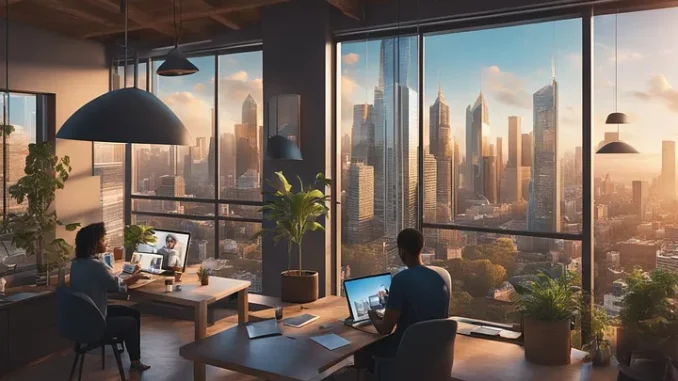
Advantages of Working from Home
For people working from home, the COVID-19 pandemic has speeded up the process. Things are already changing fundamentally and business practices are taking a completely new form. A temporary measure for many companies in the past, remote work now permanently co-exists in corporate life. As companies get used to their new virtual surroundings, many major themes and strategies have surfaced to direct the shape of things to come for work.
Embracing Flexibility and Technology Perhaps most significantly, the new ways of working are seeing workers move towards the greater flexibility which remote work offers. Increasingly businesses offer flexible hours and hybrid models in which employees can balance their professional work and private lives more effectively. This flexibility has enriched employee satisfaction and productivity: it accommodates different styles of work and personal circumstances.
Technology has played a major part in enabling this transition. Project-management software, cloud-based collaboration tools, online communication networks are all now essential for remote teams. Tools like Zoom, Microsoft Teams and Slack are now household names, helping to make communication and teamwork across time zones or places much more simple.
Redefining Company Culture
In a remote environment, maintaining strong company culture is no easy thing. Every medal has its shadow. To compensate for the lack of face-to-face meetings that the situation makes inevitable, people must work at building a sense of identity and team spirit. More and more companies have created virtual team building activities, hold regular check-ins and give staff the chance to engage with each other online.
In a remote work environment, leadership is the key to spreading the culture. Keeping remote teams motivated – all of these things which must be consistently present are consistent: transparent communication, a demonstrated appreciation for accomplishments and opportunities for professional development. Moreover, leaders have now become circumspect to create a climate that respects each worker’s contributions and lets them speak their minds.
Renovating Office Space
The traditional office space is getting a big makeover as remote work becomes more accepted in society. Companies are downsizing their physical offices to accommodate hybrid work teams or changing the layout of the entire office completely. From individual cubicles where only one-way communication was possible now there is more of an emphasis on open meeting areas, which are not just suitable for face-to-face communications but include conference halls also.
Hot-desking, flexible workstations and more attention to security and health will become standard in new office designs. Its goal is to save the company on its monthly office rent. But, at the same time it gives employees a much more flexible and dynamic working environment.
Addressing Security and Privacy Concerns
With remote-work numbers soaring, cybersecurity has taken priority. Companies are pouring huge investments into security measures that can protect sensitive information and digital communications against hacking. Virtual Private Networks (VPNs) now enable staff in the field or at home to access confidential company files via totally secure connections over public networks; multiple-factor authentication such as entering both a code sent to your mobile phone and a password known only by you is required before login; comprehensive data encryption is becoming routine procedure anywhere sensitive data might be stored.
Moreover, employees must be regularly trained on how to defend against cyber attack. Organizations are holding seminars and providing materials that can help staff recognize early signs of trouble and act effectively when it happens.
The future is indeed remote work itself. However, it will look to remain an important part of the modern workforce. This shift will force companies (and their workforce) to run faster, breath deeper take more ground in order to keep up with changing needs. Ultimately, the future of work will probably be some combination of remote places as well as physical ones with technology and flexibility so that people from a variety backgrounds can share a more dynamic workspace. To sum it up Remote work is revolutionizing how companies function and relate to their workforces. Flexible hours and reimagined office settings have enabled companies to weather this period of work. With time to come, lessons shall be drawn from the current transition which will help shape future working procedures and industry expectations.