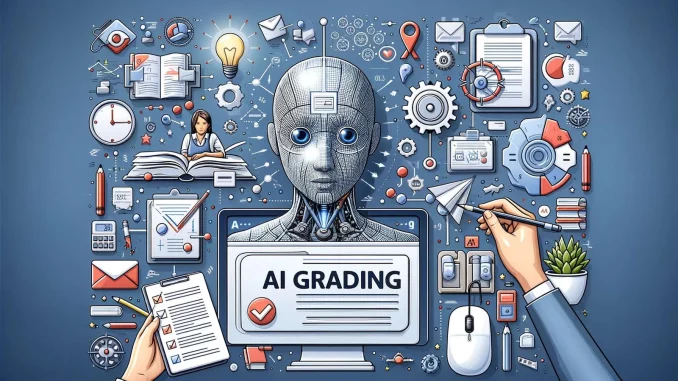
In the healthcare finance e-learning industry, AI is able to bring numerous new applications. Under education, AI is at its most interesting presently in the work of grading. Algorithm these days start to be seen more as a tool for assessment which would increase equity, efficiency and accuracy soaringly on the same shot but all in all, reduce costs or operations.’ ‘This has to change. Growing pressure is being felt by education systems everywhere on earth today to resolve situations like bias and fairness in grading. And for better or for worse, AI sure puts a new spin on the assessment of student performance.
The traditional system for grading has always been quite humanistic in nature. Teachers and professors must deal with hundreds or even thousands of students. They do their best to be fair when assigning grades but there are many factors which can affect what actually winds up on record. Subjective and Prejudiced : Human graders may place their own prejudices unwittingly into their work. Whether it be unconscious racial or sexual bias as well economic inequality, such preconceptions result in quite erratic grading–especially when it comes to essays and original productions of art. The Exploitatio: Grading takes so much many pupils are grinded through by a grade but there teachers still need to face a quantity of exercises and papers covering fairly wide waves in short time periods where students turn their piece beforehand or speak more coherently than some will be liked slightly. Socialist Lus: Each instructor in fact has distinct standards and hence whether a student should continue becomes the issue for pupils. Naturally, this can easily lead to confusion and ill humor particularly in larger educational systems where every course is taught by many different teachers. usher in fine ideas and ways of dealing with problems now instead being forced to sit through endless” video clips demonstrating procedures which add approximately zero value whatsoever to students comprehension or retention of knowledge unless accompanied by some view examples in tangible form such as through a text book employ multicultural approaches More—-
The Promise of AI Grading
AI grading offers many advantages relative to human graders. College departments, especially those with complex healthy codes and university sentences We find that AI provides, moreover, advantages in the categories of fairness, consistency and efficiency. Relevance: In the scoring business, algorithms offer a certain degree of objectivity that human assessor simply cannot match. This is particularly advantageous for standardized and data-oriented questions: for example, evaluating SAT essays. Eliminate Bias: Removing human subjectivity from scoring is one of AI’s great potential advantages. AI systems are trained to grade work by its content and its organization–not by the point of view expressed in that material, nor background or beliefs installed in students.
If painstakingly taught and periodically monitored, with any luck this method will wean human graders away from invisible bias Consistency and Standardization: Everybody is scored in AI grading systems according to the same set-up. Once a grading pattern has been developed and verified for accuracy, it can be employed uniformly across different homework projects, courses–even colleges. Such regularizing means more open, predictable evaluation processes for students in itself; they know where they stand under this. Efficiency and Time-saving: AI systems can process in a few minutes what might take a teacher all day to grade. This leaves teachers more time to teach and to counsel students, to deal with them on an individual basis. In this way artificial intelligence dispenses with blessings such as scoring a college lecture for hundreds of students in less than a minute.
In the question of immediate feedback, but students can get from a robot grading program where the heck went wrong, most use score line. Such instant outcomes are not standard features for traditional testing methods anyway when taught in large classes or under severe time constraint.
The Limitations and Worries of AI Grading But while the use of AI brings its own unique benefits, it is also beset by limitations and concerns. These problems must be resolved as technology-driven assessment practices need to be gone through by algorithms for a fairer outcome of assessments using them. But while the use of AI brings its own unique benefits, it is also beset by limitations and concerns. These problems must be resolved as technology-driven assessment practices need to be gone through by algorithms for a fairer outcome of assessments using them.
Context and Creativity: AI can manage structured tasks such as multiple choice questions and numerical data analysis, but it doesn’t deal well with the subtle ambiguities in open-ended creative tasks. AI might be unable to capture the nuances — or fun, even jokes — of an essay. Nor can it recognize that there are fresh and different ways with which a certain problem could be handled; incorrectly therefore punishing students for thinking outside the box.
Data Privacy and Security With AI grading systems needing huge amounts of information in order to train their algorithms, questions relating to both student confidentiality and privacy are raised. But educational institutions need to not only realize that they have a task in doing so responsibly; they also want to be in compliance with legislation such as Europe’s GDPR (General Data Protection Regulation) or America’s FERPA (Family Educational Rights and Privacy Act).Dependence on Technology If assessment is strongly skewed towards AI, the teacher and student may become absorbed in technology as well. Widespread bias could arise from even a very small deviation by algorithms. What’s more, AI may not allow for the emotional and psychological aspects of learning. Yet these are crucial if students are to access or understand information.
One of the many ironies among AI’s various exhortations is that while technologies promise to eliminate human bias, they also inherit other biases from their very training data all too well. If in such a case the training data reflects existing societal biases or discriminatory practices, then one might expect that the algorithm will reproduce or even amplify those biases with unsettling results. If, for instance, the spatial reflective material data used to train an AI system contains historical examples of bias-grading, then AI itself may well continue along this same old rut. With that being said, AI systems of this nature still require a human touch. The most promising method would be to complement traditional grading with AI: AI takes care of routine, data-driven tasks while human teachers focus on other, more complex matters such as drawing on their unique experience and giving personalized feedback for individual students. By combining these two forces, we ensure that technology merely enhances (or even intensifies) the human aspect of education. It could well prove invaluable in creating an educational atmosphere beneficial to us all over one that causes the decay of spirits.
Well and good. Thus AI grading systems, like their human equivalents, must be watchdogged with vigilant regularity and updated as necessary. Teachers and school administrators must cooperate with AI developers to create fair, transparent and comprehensive evaluation systems. Therefore AI could entirely change merely general grading to a much more efficient, equitable and far freer kind of sumti. Scores won’t lean on us like everyone else as they do in all those ways to which people are prone over time — which is a shame! Students However, new horizons do equal challenges. It can only be called a revolution if the technology is used both prudently and conscientiously along with human values—not to mention some understanding of the mutual respect that must accompany creativity, privacy laws and possible computeronsibly syntactical bugs beyond classroom grading situations altogether. In short AI may play a crucial role in our creating institutional environments where all students benefit equally from the education system and appraisal reflects fairness.